

Companies House Identity Verification: Director and PSC Guide for 2026
Companies House identity verification explained for directors and PSCs, with deadlines, personal codes, confirmation statements, and penalties.
Companies House Identity Verification: Director and PSC Guide for 2026
Companies House identity verification is now a real compliance job for limited company directors and PSCs, not a future admin note you can leave in a drawer. Since 18 November 2025, identity verification has been a legal requirement, and plenty of small company owners are only realising the practical effect when the next confirmation statement, new appointment, or shareholding update lands on the desk.
The awkward bit is that there are two separate actions. First, you verify your identity. Then you provide your Companies House personal code in the right filing or service for the role you hold. Miss that distinction and it becomes oddly easy to think the job is done when it is only half done.
Quick summary: directors need to give their personal code in the company’s next confirmation statement. If you are also a PSC, you usually need a second step for that role. Existing PSCs who are not directors normally have a 14 day window in the first 14 days of their birth month. New PSCs can give their code when first added to the register, or within 14 days of being added.
If you want help tying this into your wider company compliance work, we can support you through our annual accounts service, company formation service, and contact page.
What Companies House identity verification means in practice
For most small company owners, the headline change sounds simple enough. Directors and people with significant control, usually called PSCs, must verify their identity for Companies House. A PSC is usually someone who owns or controls the company, often because they hold more than 25% of shares or voting rights, can appoint or remove most of the board, or otherwise has significant influence or control over the company.
The thing is, Companies House has not attached one neat deadline to everyone. The rules depend on your role and when you took it on. That is why there is so much confusion. A director of an existing company, a sole director who is also the sole shareholder, and a non-director shareholder with more than 25% of the shares do not all follow the same timetable.
There is also a second misunderstanding that keeps causing trouble. Identity verification does not replace your confirmation statement, annual accounts, or Company Tax Return. Those jobs still exist on their normal timetable. If identity verification slows down your filing process, Companies House and HMRC do not suddenly become sentimental about your other deadlines.
For a private limited company, the usual filing cycle still looks like this:
| Task | Normal deadline |
|---|---|
| File annual accounts with Companies House | 9 months after your financial year end |
| Pay Corporation Tax | 9 months and 1 day after the accounting period ends |
| File Company Tax Return | 12 months after the accounting period ends |
That matters because directors often tackle Companies House jobs in a batch. If identity verification is missing, the blockage can spread into other work very quickly.
Official pages worth keeping open while you read:
- Verify your identity for Companies House
- When you need to verify your identity for Companies House
- Companies House personal codes for identity verification
- Accounts and tax returns for private limited companies
Companies House identity verification: who needs to act, and when
The easiest way to stay sane is to separate the rules by role.
| Role | What you need to do | Main timing point |
|---|---|---|
| Existing director | Verify identity, then provide personal code | In the company’s next confirmation statement |
| Director of more than one company | Verify once, then reuse the code | Provide the same code for each company |
| New director | Verify identity first | Provide code as part of the appointment filing or incorporation |
| Existing PSC who is also a director | Verify identity, then do two role-specific steps | Director code in confirmation statement, PSC code in the PSC service within the 14 day PSC window |
| Existing PSC who is not a director | Verify identity, then provide code | Usually within the first 14 days of your birth month |
| New PSC after 18 November 2025 | Verify identity, then provide code | When first added to the register, or within 14 days of being added |
That table is the bit most owners wish they had seen first.
Worked example 1: sole director and sole shareholder
Assume Maya runs a one-person limited company. She is:
- the only director
- the only shareholder
- the only PSC
Her company’s confirmation statement date is 30 April 2026.
What happens?
- Maya verifies her identity and gets her personal code.
- As a director, she gives that code in the company’s next confirmation statement.
- As a PSC, she must also provide the code through the PSC identity verification service.
Her PSC window starts the day after the confirmation statement date, so the practical window is:
- 1 May 2026 to 14 May 2026
If the confirmation statement is filed early, that does not move the PSC dates. That catches people out because early filing feels like it should clear everything. It does not.
Verification and personal codes are two separate jobs
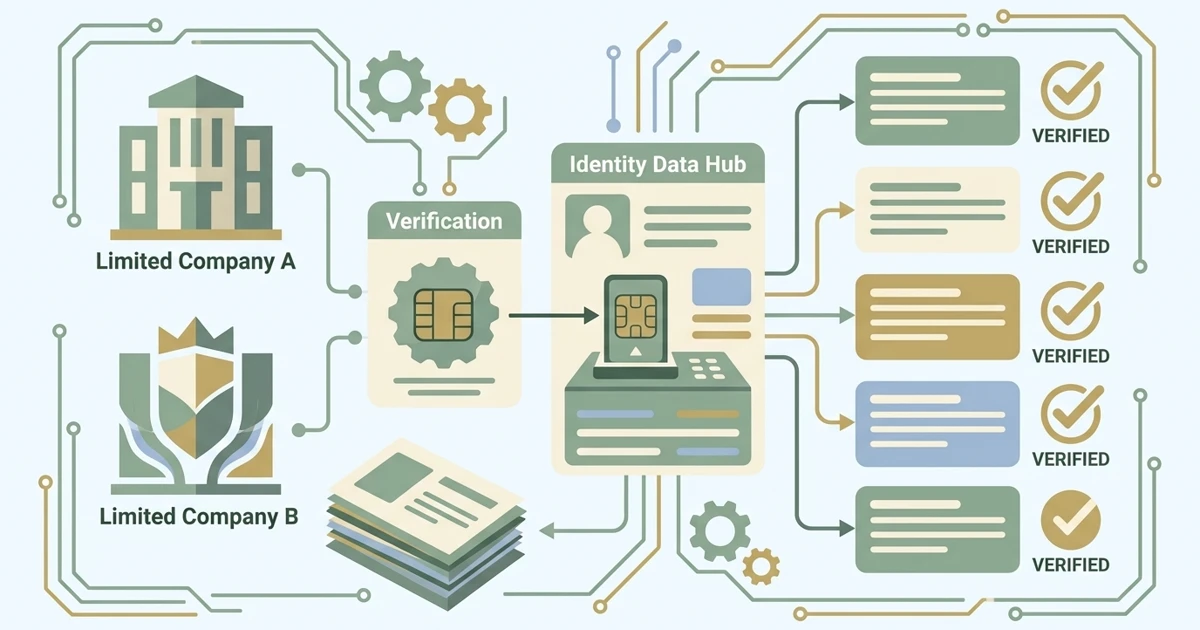
Once your identity is verified, Companies House gives you an 11 character personal code. The code is personal to you, not to the company. You use that code when you need to confirm you are verified for a role.
That sounds like minor admin wording, though it changes how you should plan the job. Think of it like this:
- verification proves who you are
- the personal code links that verified identity to the company role
If you only complete the first half, you have not finished.
The good news is that you do not need to verify again every time you take on another company role. One verified identity can cover multiple appointments.
Worked example 2: one director, three companies
Assume Daniel is a director of 3 limited companies:
- Company A
- Company B
- Company C
He verifies his identity once and receives one personal code.
He does not need:
- 3 separate identity checks
- 3 separate personal codes
He does need to use the same code when confirming he is verified for each appointment. So one identity check can support all 3 directorships, but each company still needs the filing step done properly.
That matters if you sit on a couple of family companies, property companies, or SPVs. The job is smaller than it first appears, but only if you understand that the code is reusable.
The snags that trip up directors and PSCs
Most problems are not legal problems at the start. They are admin problems that then become legal problems because the deadline rolls closer.
The common trouble spots are:
- trying to verify at the Post Office without first entering photo ID details online
- assuming a confirmation statement covers the PSC step automatically
- finding out the date of birth on Companies House records does not match the verified identity details
- using a shared email address and discovering each verified identity needs its own GOV.UK One Login
- assuming the work can wait until annual accounts are ready
That third point is especially irritating. If your date of birth or other personal details do not match Companies House records, the system may not connect your verified identity to the role cleanly. It is one of those boring data issues that can burn a lot of time.
Worked example 3: the date mismatch problem
Assume a director verifies identity successfully on 20 April 2026 and gets a personal code the same day. Their company’s confirmation statement needs to be filed by 30 April 2026.
Then they discover the date of birth on Companies House records is wrong.
What happens next?
- the identity check itself may be fine
- the personal code still exists
- the code may not connect to the director role until the Companies House record is corrected
In practical terms, that can turn a ten-minute task into a week of back-and-forth right when the confirmation statement deadline is sitting there waiting.
If you are close to a filing date, it is worth checking the company record now rather than on the final afternoon.
Why this matters for your wider filing calendar
The confirmation statement is only one item in the annual company compliance bundle. If identity verification delays that filing, it can create exactly the sort of messy last-minute scramble most directors were hoping to avoid.
For example, companies with a 31 July 2025 financial year end generally need to file annual accounts with Companies House by 30 April 2026. Miss that deadline and the late filing penalty for a private limited company starts at:
| Delay after annual accounts deadline | Penalty |
|---|---|
| Up to 1 month | £150 |
| 1 to 3 months | £375 |
| 3 to 6 months | £750 |
| More than 6 months | £1,500 |
The penalty is doubled if accounts are filed late 2 years in a row.
Worked example 4: when a blocked filing becomes an avoidable penalty
Assume a company with a 31 July 2025 year end should file annual accounts by 30 April 2026.
Now assume the company is not ready to complete related Companies House admin because the sole director has not sorted identity verification and the confirmation statement work has stalled the rest of the filing timetable.
If the accounts end up filed on 20 June 2026, the filing is:
- 1 month and 21 days late
That pushes the company into the 1 to 3 months late band, so the penalty is:
- £375
If the company was also late the previous year, the penalty doubles to:
- £750
That is before you count the time wasted, the stress, and the fact Companies House can also strike a company off the register for more serious non-compliance around accounts or confirmation statements.
The point is not that identity verification creates the accounts penalty directly. It is that a blocked Companies House process often throws off the whole compliance month.

Should you verify yourself or use an ACSP?
You have two main routes.
Option 1: verify directly through GOV.UK One Login
This is the obvious route if:
- your Companies House records are tidy
- your passport or driving licence details are current
- you are comfortable dealing with the process yourself
If you do not have the usual photo ID, the service may point you towards other options such as bank or building society details, or an in-person Post Office route. Worth knowing though, the Post Office option is not really a shortcut. You still need to enter your photo ID details online first.
Option 2: ask an ACSP to verify on your behalf
An Authorised Corporate Service Provider, usually an accountant, solicitor, or company formation agent, can verify your identity for you.
This can be sensible if:
- the online route is failing
- there is a mismatch in personal details
- you have several directors or PSCs to organise
- you want somebody to handle the filing sequence properly
If we are already looking after your annual accounts or helping with company formation in the UK, this is usually easier to coordinate alongside the rest of your Companies House work rather than treating it as a separate job.
A practical checklist for directors and PSCs
If you want the short version, this is the order we would use.
| Step | What to check | Why it matters |
|---|---|---|
| 1 | Confirm who is a director and who is a PSC | Some people are both, which creates two filing actions |
| 2 | Verify each person’s identity | No personal code without this step |
| 3 | Save each personal code securely | The same code can be reused later |
| 4 | Check dates of birth and personal details on Companies House records | Mismatches can block the role-linking step |
| 5 | File the confirmation statement with director codes included | Existing directors need the code here |
| 6 | Complete the PSC code step separately where required | This is often the bit people miss |
| 7 | Keep annual accounts and Corporation Tax deadlines in the same diary | Identity verification does not move the rest of the timetable |
One dry but important point. Do not leave this entirely with “the accountant” unless you know exactly who is doing which part. Some firms can verify identity as an ACSP. Some cannot. Some will prepare the accounts but still expect you to sort the Companies House identity process yourself. Make the ownership clear now.
What small company directors should do this week
If your company has a confirmation statement due in the next month or two, the sensible move is to get identity verification done before the filing window becomes urgent.
Start with these questions:
- Are all current directors verified?
- If any director is also a PSC, has the PSC step been planned as well?
- Is the date of birth on Companies House correct for each person?
- Do you know where the personal code is stored?
- Is someone actually responsible for the confirmation statement filing?
That last one matters more than it sounds. Compliance slips because everyone assumes someone else will press the final button.
If you want us to review the filing calendar and take the pressure off the company admin side, get in touch. We can help you line up the Companies House pieces with your annual accounts and tax deadlines, so you are not fixing one deadline while another one sneaks up behind it.
FAQ: Companies House identity verification
Is Companies House identity verification mandatory?
Yes. Identity verification became a legal requirement from 18 November 2025 for the relevant roles.
Who counts as a PSC?
A PSC is usually someone who owns or controls the company, often by holding more than 25% of shares or voting rights, having the right to appoint or remove most directors, or otherwise exercising significant influence or control.
Do I need a separate identity check for every company?
No. You verify your identity once, then use the same personal code when confirming you are verified for each relevant appointment.
If I am both a director and a PSC, is one filing step enough?
Usually not. You normally need to give your code in the confirmation statement for the director role and also complete the PSC step separately.
Can I use the Post Office route straight away?
Not quite. If you are verifying via the Post Office route, you still need to enter your photo ID details in the GOV.UK service first.
What if my personal details do not match Companies House records?
Check the company record, especially your date of birth. If the details do not match, you may need to correct the record before your verified identity can be linked properly.
Does identity verification replace annual accounts or the Company Tax Return?
No. Annual accounts, Corporation Tax payment, and the Company Tax Return still keep their usual deadlines.
The point to act on now
Treat Companies House identity verification as part of your normal year-round compliance routine, not as a one-off tech task. Verify the people, store the personal codes properly, and line the work up with your next confirmation statement before the deadline becomes annoying. That is the version that stays calm.

About Golden Tree Consulting
AAT Licensed | ACCA Affiliated
Golden Tree Accounting & Business Consulting provides expert tax, bookkeeping, and advisory services to sole traders and SMEs across Croydon, London, Surrey, and Kent. With multilingual support and decades of combined experience, we help businesses stay compliant and grow.
More Articles You Might Like
Continue exploring our financial insights

Companies House Identity Verification 2026: Director and PSC Guide
Companies House identity verification explained for directors and PSCs in 2026, with personal codes, deadlines, and examples.
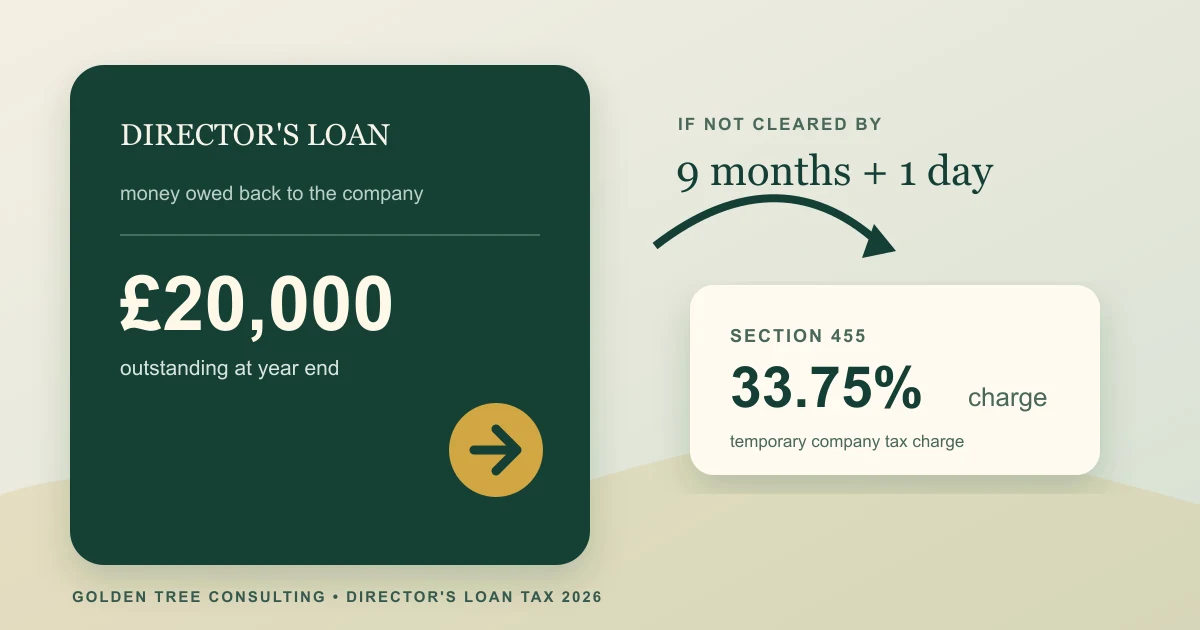
Director's Loan Tax 2026: Section 455, the £10,000 Rule and 9-Month Deadline
Director's loan tax 2026 explained: Section 455 at 33.75%, the £10,000 benefit rule, repayment timing and worked examples.

ERS Return Deadline 6 July 2026: Share Scheme Guide for UK Employers
ERS return deadline 6 July 2026 explained, with EMI notifications, nil returns, penalties, share events, and employer checklist.