
Director's Loan Tax 2026: Section 455, the £10,000 Rule and 9-Month Deadline
Director's loan tax 2026 explained: Section 455 at 33.75%, the £10,000 benefit rule, repayment timing and worked examples.
Director’s Loan Tax 2026: Section 455, the £10,000 Rule and 9-Month Deadline
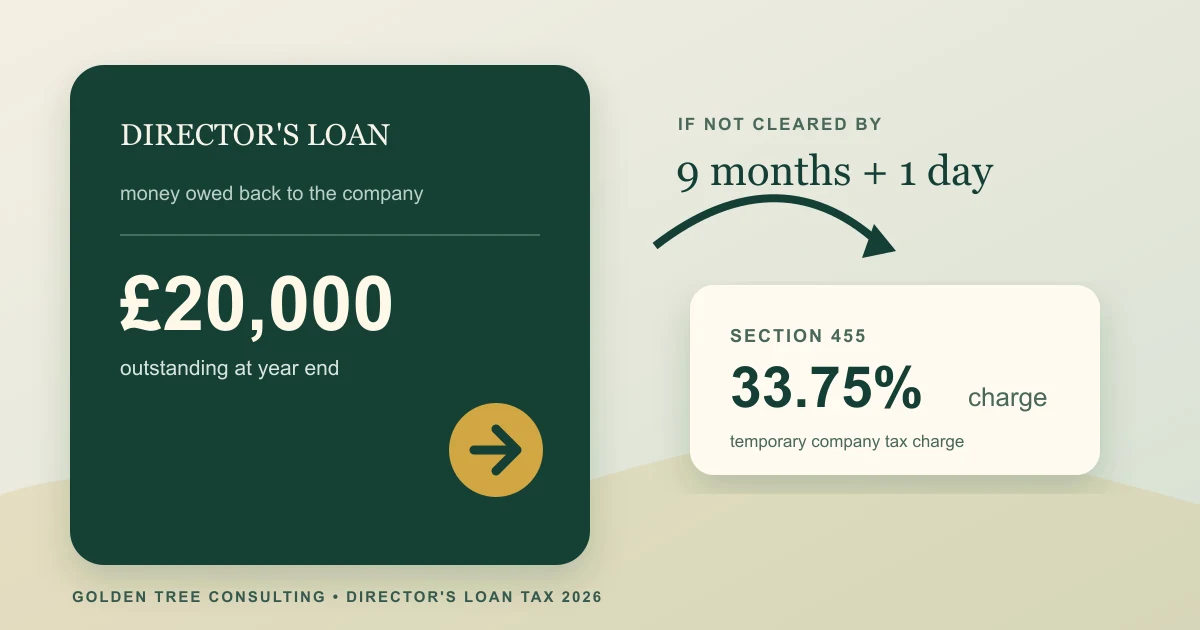
Director’s loan tax in 2026 can become expensive surprisingly quickly. A transfer to your personal account, a company card used for a private bill, or a dividend taken before the paperwork is ready can all leave you owing money to your limited company. If the balance is still there nine months and one day after the company year end, the company can face a temporary Section 455 charge of 33.75%.
That charge is not the same as your usual Corporation Tax bill, and it is not a personal income-tax bill either. It is a separate close-company tax charge designed to stop shareholders using company funds as an open-ended substitute for dividends. The company may reclaim it later, but the timing can be painful when cash is already tight.
Quick summary: check the director’s loan account before finalising your company accounts. A balance that remains unpaid nine months and one day after the accounting period can trigger Section 455 at 33.75%. A loan above £10,000 can also create a taxable benefit if it is interest-free or charged below HMRC’s 3.75% official rate for 2026/27.
If your records contain regular drawings, personal bills, or transfers between personal and company accounts, our company accounts service and bookkeeping support can help establish the real balance before the filing deadline turns into a cash-flow problem.
What counts as a director’s loan account?
A director’s loan account, often shortened to DLA, is simply the running record of money moving between you and your company outside normal salary, dividends, expense repayments, or money you put into the business. It can be in credit, meaning the company owes you money, or overdrawn, meaning you owe the company.
The overdrawn position is the one that needs attention. Common causes include:
- taking cash from the company bank account for personal spending
- paying a personal bill with the company card
- withdrawing money before a dividend has been properly declared
- claiming a business cost personally but not posting the reimbursement
- treating the company account like a sole-trader drawings account after incorporation
The last point catches many new directors. A limited company is a separate legal person. Its bank balance is not your personal spending pot, even if you own every share. The account should show each movement clearly, with invoices and receipts for genuine company costs and paperwork for salary or dividends.
HMRC’s director’s loans guidance confirms that personal and company tax responsibilities depend on how the balance is settled. That is why a quick balance check is useful before accounts are signed, not only when the CT600 is due.
The Section 455 nine-month rule in 2026
Section 455 applies to loans from close companies to participators. In a typical owner-managed company, a shareholder-director is a participator. If they owe the company money at the year end and the loan is not repaid within nine months and one day after that accounting period ends, the company normally pays the charge through its Company Tax Return.
For loans made on or after 6 April 2022, the rate is 33.75% of the outstanding loan. HMRC’s guidance uses the same figure for the ordinary unpaid-loan case and for certain anti-avoidance situations.
| Company accounting period ends | Loan cleared by | What happens if it is still outstanding? |
|---|---|---|
| 31 March 2026 | 1 January 2027 | Section 455 may be due with the Corporation Tax bill |
| 30 June 2026 | 1 April 2027 | Section 455 may be due with the Corporation Tax bill |
| 31 December 2026 | 1 October 2027 | Section 455 may be due with the Corporation Tax bill |
The tax payment date is normally nine months and one day after the accounting period. The CT600 filing deadline is later, at 12 months after the period end, so do not assume that waiting to prepare the return also postpones the money due.
Worked example 1: the cash-flow hit
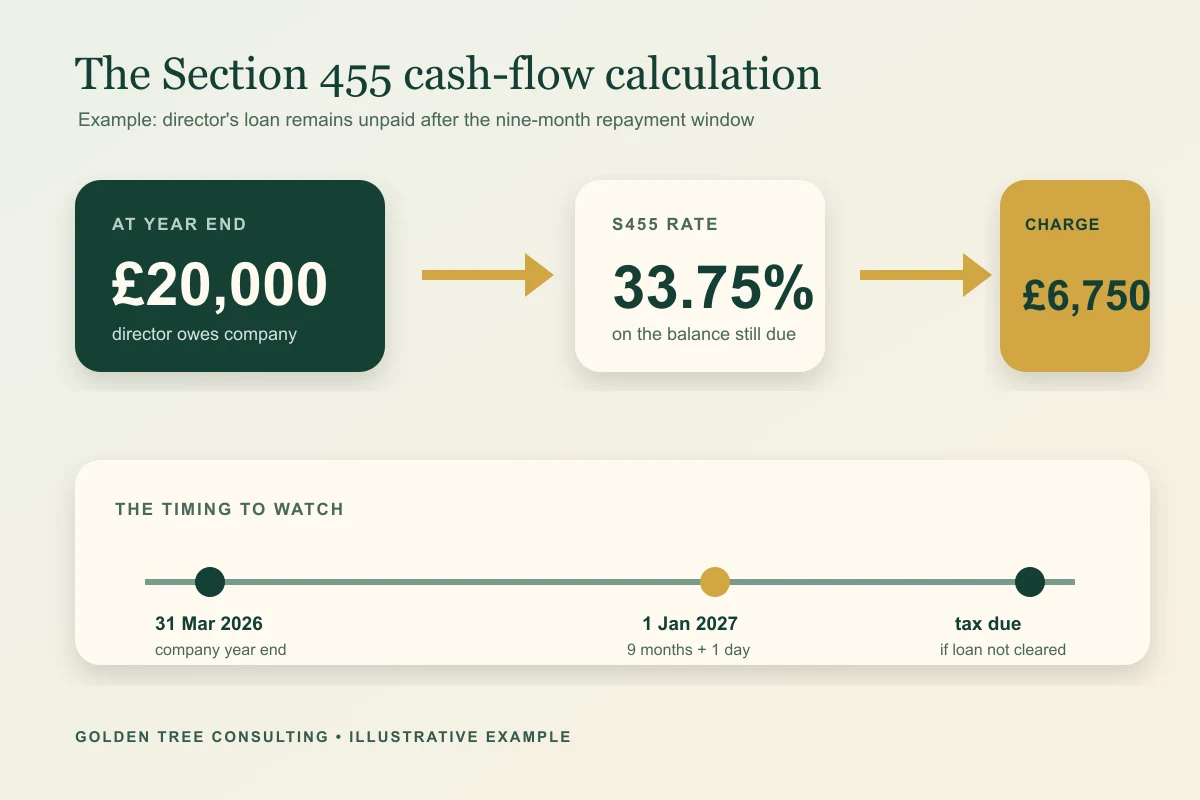
Assume Priya is the sole shareholder and director of a company with a 31 March 2026 year end. Her director’s loan account is overdrawn by £20,000 at that date. She has not repaid it by 1 January 2027.
| Calculation | Amount |
|---|---|
| Outstanding loan | £20,000 |
| Section 455 rate | 33.75% |
| Section 455 charge | £6,750 |
The company, not Priya personally, pays the £6,750 to HMRC. The original £20,000 still remains due back to the company. It is a cash drain, not a clever way of delaying tax.
There may also be late-payment interest if the charge is not paid on time. Your individual circumstances, any earlier loans, and the company accounts all matter, so do not use a quick calculation as a substitute for reviewing the actual ledger.
Can the company reclaim Section 455 tax?
Usually, yes. Section 455 is intended to be temporary if the loan is genuinely repaid, written off, or released. But the reclaim is not immediate. HMRC says relief is due nine months and one day after the end of the accounting period in which the loan was repaid, written off, or released. Interest paid on the Section 455 charge is not refundable.
Take Priya’s £20,000 loan again. If she repays it in full on 15 May 2027 and her company has a 31 March year end, the repayment falls in the year ending 31 March 2028. The company cannot expect the Section 455 relief before 1 January 2029. That is a long time for £6,750 to be unavailable for payroll, stock, VAT, or a quiet trading month.
HMRC gives different claim routes depending on timing. A claim within two years of the end of the accounting period in which the original loan was made can normally be handled through CT600A or an amendment. Later claims use form L2P. The CT600A notes and HMRC guidance are worth checking with the specific accounts period in front of you.
The £10,000 director’s loan rule and the 3.75% official rate
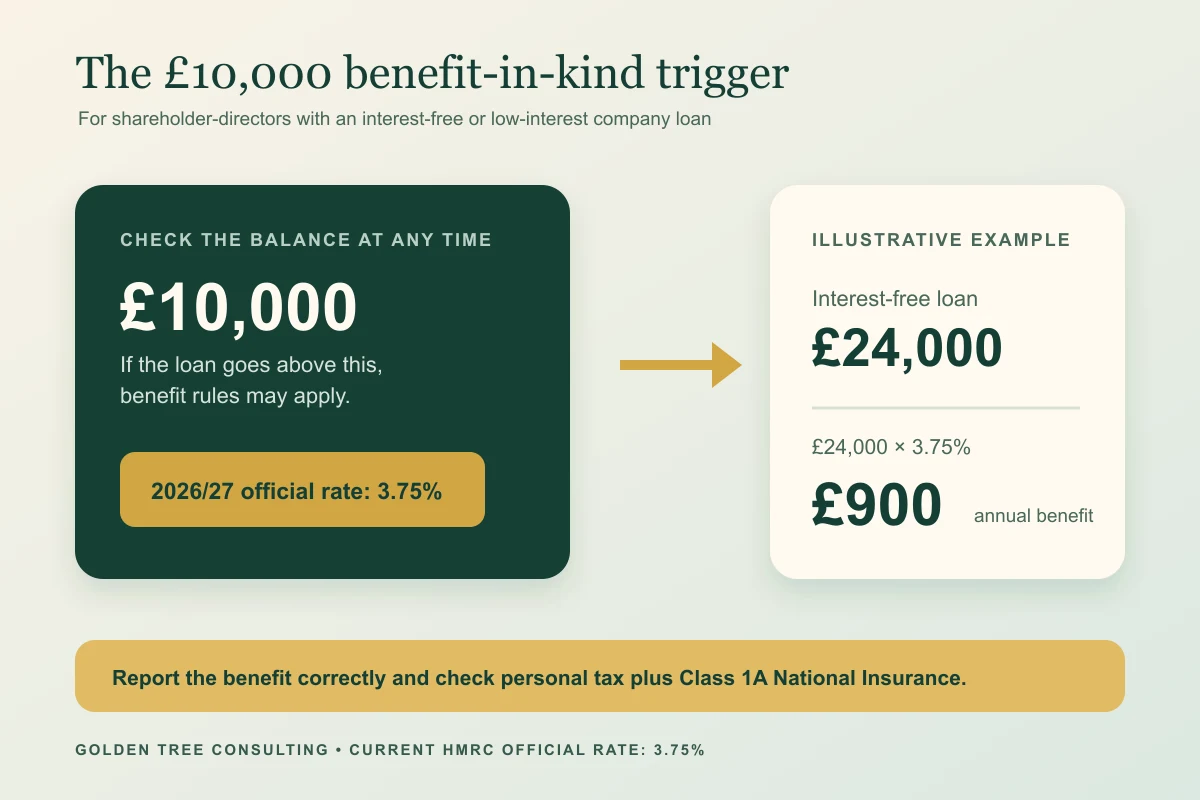
Section 455 is only part of the story. If you are a shareholder and director and owe your company more than £10,000 at any time in the tax year, an interest-free or low-interest loan can become a benefit in kind. HMRC says the company must treat it as a benefit, report it, and deal with the National Insurance position.
For loans outstanding from 6 April 2026, HMRC’s official rate is 3.75%. If you pay less than that rate, the benefit is broadly the difference between interest calculated at the official rate and the interest you actually pay. The company must record below-official-rate interest as company income and the discounted amount as a benefit. You may then have personal tax on that benefit.
The £10,000 test is about the amount owed at any time in the year, not merely the balance on 5 April. Small movements can matter if a balance briefly crosses the line.
Worked example 2: an interest-free £24,000 loan
Suppose Ben owes his company £24,000 throughout the 2026/27 tax year and pays no interest. Ignoring any repayments or changing balances, the headline benefit calculation is:
| Calculation | Amount |
|---|---|
| Average loan balance | £24,000 |
| HMRC official rate for 2026/27 | 3.75% |
| Interest benefit before any interest paid | £900 |
If Ben is a basic-rate taxpayer, a simplified estimate of Income Tax on a £900 taxable benefit is £180. The company may also face Class 1A National Insurance on the benefit. The exact result can differ where the balance changes during the year, interest is paid, the loan is repaid by the relevant date, or exemptions apply. HMRC’s beneficial-loan rate guidance is the current source for the 3.75% rate.
Repaying the loan: why the timing and source matter
Putting money back before the nine-month deadline can avoid the ordinary Section 455 charge, but a repayment needs to be real. HMRC has anti-avoidance rules aimed at “bed and breakfasting”, where a director repays a loan only to draw substantially the same money again soon afterwards.
Two broad situations are worth flagging:
- if you repay more than £5,000 and borrow £5,000 or more again within 30 days before or after the repayment, the repayment may be matched to the new loan rather than clearing the old one
- if you repay more than £15,000 and, when making the repayment, arrangements already exist for another loan or advance, similar rules can apply
HMRC’s published director-loan page gives these thresholds and can still charge 33.75% where the matching rules bite. A quick transfer out and back is not a safe fix.
A real repayment might come from money you introduce personally, a salary processed correctly through PAYE, a properly declared dividend supported by distributable profits, or a genuine credit already due to you. Each route has its own tax, paperwork, and cash consequences.
Worked example 3: do not use an unsupported dividend
Imagine Marco owes his company £18,000. The company has only £5,000 of distributable post-tax profit, but he wants to clear the whole balance by posting an £18,000 dividend at year end.
That does not solve the problem. A dividend must be supported by profits available for distribution, with minutes and a dividend voucher. Posting £18,000 when only £5,000 is available can create an unlawful distribution rather than a valid repayment. The practical choices may be a £5,000 valid dividend plus a £13,000 cash repayment, a properly run salary, or an agreed longer-term plan. We would check the full accounts first, including Corporation Tax, payroll and personal tax.
Our salary versus dividends guide explains why the personal tax rate is only one part of this decision. If cash is tight, speak to us before moving money. A clean plan in July is much easier than untangling a director’s loan account after the year end.
Written-off loans are not the easy route
Writing off or releasing a loan does not make it disappear tax-free. HMRC says the company must deduct Class 1 National Insurance through payroll and the director must report the written-off amount on their Self Assessment return. The director can then have Income Tax to pay.
There is also a company-law and accounting question. You need to know who has authority to release the debt, whether the company can afford it, and whether the accounting records describe the transaction properly. It is one of those areas where the rules get fiddly very quickly.
For a company with limited cash, a write-off can replace one problem with a different and sometimes bigger one. Ask for advice before recording it.
A practical director’s loan account checklist
Use this checklist before your accountant starts the year-end work:
- Reconcile the director’s loan account to bank transfers, company-card transactions, expenses, salary and dividends.
- Identify the balance at the accounting date, not only the balance today.
- Put the nine-month-and-one-day payment date in the cash-flow forecast.
- Check whether the loan exceeded £10,000 at any point between 6 April and 5 April.
- Record interest charged and paid, then compare it with the 3.75% official rate for 2026/27.
- Do not assume a late journal, an unsupported dividend, or a quick re-borrowing will clear the balance.
- Keep board minutes, dividend vouchers, expense receipts and bank evidence together.
Good bookkeeping is the dull but useful answer here. A current DLA balance lets you decide while there are options. A surprise discovered after accounts are finalised usually means fewer choices and more tax to fund.
FAQs about director’s loan tax in 2026
How much is Section 455 tax in 2026?
For relevant loans made on or after 6 April 2022, the Section 455 charge is 33.75% of the loan outstanding nine months and one day after the end of the company’s accounting period. It is paid by the company and may be reclaimable later when relief conditions are met.
Is a director’s loan under £10,000 tax-free?
Not necessarily. The £10,000 figure relates to the beneficial-loan rules for shareholder-directors. A smaller overdrawn loan can still need recording on CT600A and can still face Section 455 if it remains unpaid after the nine-month deadline. Other tax rules may also apply to the facts.
Can I clear my director’s loan account with a dividend?
Possibly, but only if the company has enough distributable profits and the dividend is properly declared and documented. A journal entry alone does not create a valid dividend. It may also create personal dividend tax, so compare the full result before acting.
When does a company get Section 455 tax back?
The company can claim relief after the loan is repaid, written off or released, but HMRC says the relief is not due until nine months and one day after the end of the accounting period in which that event occurs. Interest paid on the original Section 455 charge is not refunded.

About Golden Tree Consulting
AAT Licensed | ACCA Affiliated
Golden Tree Accounting & Business Consulting provides expert tax, bookkeeping, and advisory services to sole traders and SMEs across Croydon, London, Surrey, and Kent. With multilingual support and decades of combined experience, we help businesses stay compliant and grow.
More Articles You Might Like
Continue exploring our financial insights

Business Asset Disposal Relief 2026: UK Guide for Small Business Owners
Business Asset Disposal Relief 2026 explained, with the 18% CGT rate, £1m lifetime limit, eligibility checks, and worked examples.

Salary vs Dividends UK 2026/27: Director Tax Guide for the New Tax Year
Salary vs dividends UK 2026/27 explained for directors, with new dividend tax rates from 6 April 2026, worked examples, and practical planning tips.

Online Accounts and Company Tax Return Service Closing: 31 March 2026 Checklist
The online accounts and Company Tax Return service closing on 31 March 2026 means action now. Use this UK checklist to switch software and avoid penalties.