
FreeAgent Pricing UK for Sole Traders: 2026 Cost and MTD Guide
FreeAgent pricing UK for sole traders in 2026, with monthly and annual costs, free routes, VAT, add-ons and MTD checks.
FreeAgent Pricing UK for Sole Traders: 2026 Cost and MTD Guide
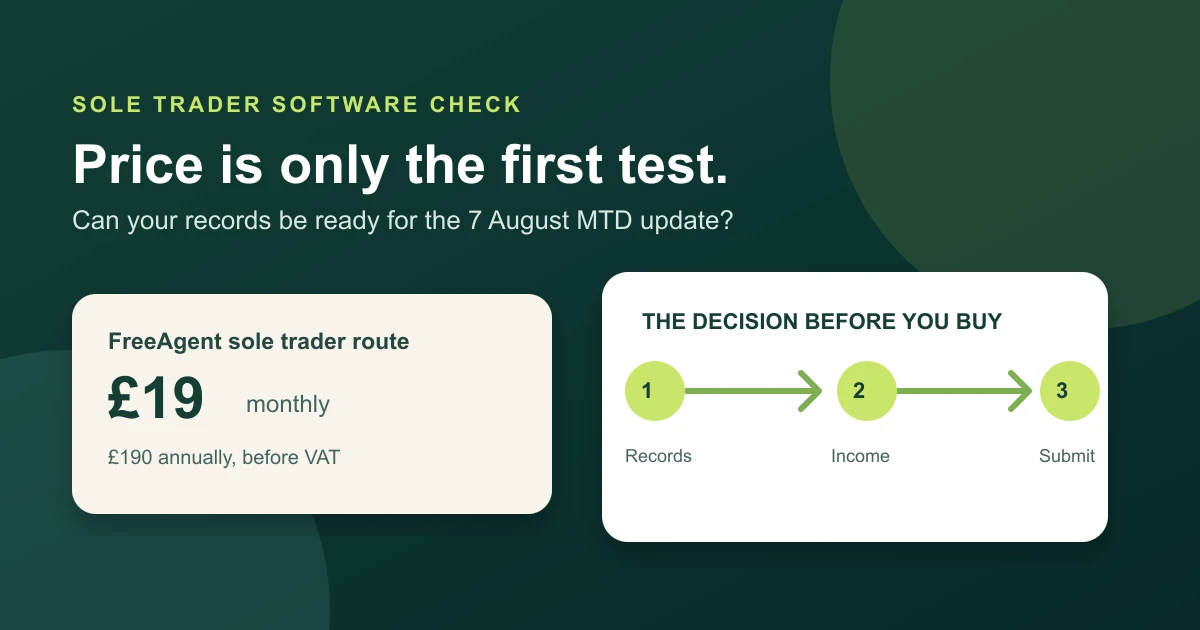
FreeAgent pricing UK searches usually start with one number, but the better question is what that number has to cover before your first Making Tax Digital update. On 17 July 2026, FreeAgent lists a regular sole trader price of £19 a month or £190 a year, both before VAT. The monthly figure looks small. The real cost can look different once you include VAT, optional tools, the time spent keeping records tidy, and whether the software can handle your full tax position.
That matters right now. For sole traders in the first MTD for Income Tax group, the first standard quarterly update for the period ending 5 July 2026 is due by 7 August 2026. The quarterly update is not your tax return, but it does depend on usable digital records. Buying software on 6 August is a fairly expensive way to discover that bank transactions still need sorting.
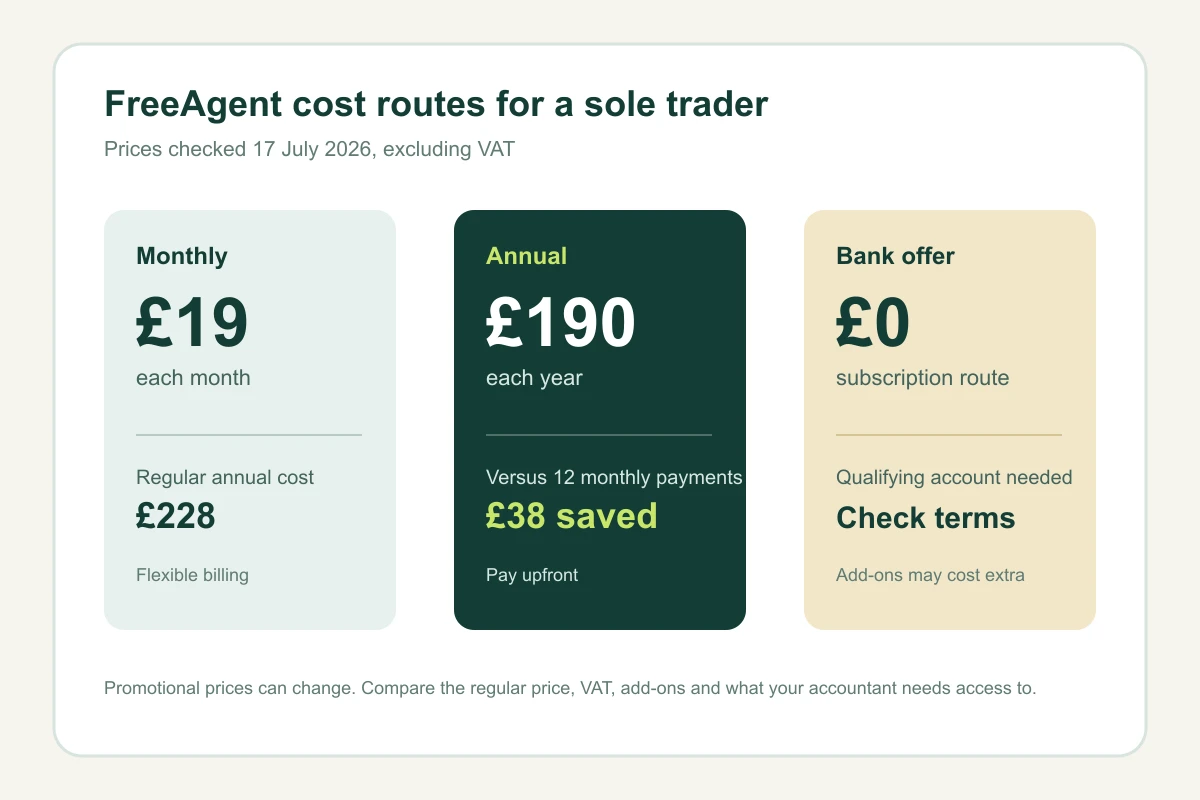
Quick summary: FreeAgent’s listed regular sole trader price is £19 per month or £190 per year, before VAT, as checked on 17 July 2026. Annual billing saves £38 against 12 regular monthly payments. A £0 route may be available through certain qualifying business bank accounts, but check the account conditions and add-ons. Before choosing any package, make sure it suits your income sources, MTD filing route and accountant access.
We can help you choose a workflow that fits the business rather than the other way around. Our bookkeeping service, Self Assessment support, and contact page are useful starting points if the records need attention before the August deadline.
FreeAgent pricing UK for sole traders in 2026
FreeAgent separates its UK pricing by business type. On its official pricing page, the regular sole trader subscription shown on 17 July 2026 was:
| Billing route | Regular price before VAT | Equivalent comparison | What to watch |
|---|---|---|---|
| Monthly | £19 per month | £228 over 12 months | More flexible, but costs £38 more than annual billing over a full year |
| Annual | £190 per year | About £15.83 per month | You pay upfront and need to be confident it is the right fit |
| Qualifying bank route | £0 subscription in some cases | Varies by account | Account eligibility, ongoing conditions and paid extras still apply |
The figures above are the regular prices, not a promise about a future promotion. FreeAgent was showing a 50% introductory offer for the first six months on monthly billing and the first year on annual billing when we checked. An offer is helpful, but it should not be the only figure in your budget. Write down the price after the offer ends, then add VAT and anything you genuinely need beyond the standard plan.
For example, a sole trader who pays monthly at the regular rate would pay £228 before VAT over 12 months. Annual billing at £190 saves £38 before VAT. If 20% VAT applies and you cannot reclaim it, that changes the cash paid to £273.60 monthly over a year or £228 annually. If you are VAT registered and can reclaim input VAT in full, the commercial cost is usually the price before VAT, subject to the normal VAT rules for your business.
The bank route deserves the same care. FreeAgent says a £0 subscription can be available to customers of certain business current accounts, including accounts that require ongoing use. It is not a reason to open an account blindly. Compare the bank’s fees, cash deposit needs, card limits, customer service and whether its conditions fit how you actually trade. A free subscription that comes with a bank account you would not otherwise choose is not automatically a saving.
What is included, and where costs can grow
The standard sole trader plan is intended to cover the practical bookkeeping jobs most one-person businesses need: invoicing, bank feeds, expense capture, estimates, cash-flow views and Self Assessment information. It also has payroll features, but a sole trader without employees should not pay attention to a feature simply because it sounds impressive. The useful test is more ordinary: can you get every business receipt, sale and payment into the right place without creating a monthly clean-up job?
FreeAgent says all businesses can use Smart Capture for up to 10 receipts and bills per month as standard. Its Smart Capture Unlimited add-on was listed at £5 per month plus VAT. The Amazon UK Marketplace add-on was listed at £6 per month plus VAT. Those extras may be worthwhile for a high-volume seller or a business that receives a stack of supplier bills, but they change the comparison quickly.
Worked example 1: a simple freelance consultant
Amir invoices four clients a month, has a business bank account, and stores around eight expense receipts a month. He does not use payroll or Amazon. His likely software decision is simple:
| Item | Monthly billing | Annual billing |
|---|---|---|
| Base subscription before VAT | £19 × 12 = £228 | £190 |
| Smart Capture Unlimited | £0 if the standard allowance is enough | £0 |
| Difference | £38 saved annually |
For Amir, the annual saving is real if he expects to use the product for the whole year. It is not a tax deduction of £38 from his tax bill. It is a business expense that may reduce taxable profit if it is wholly and exclusively for the business, subject to his own circumstances.
Worked example 2: an online seller with 25 documents a month
Priya sells handmade items online, processes around 25 receipts or supplier bills a month, and uses the Amazon integration. At the listed regular prices, her annual subscription calculation could look like this:
| Item | Calculation | Annual cost before VAT |
|---|---|---|
| Annual sole trader plan | £190 | £190 |
| Smart Capture Unlimited | £5 × 12 | £60 |
| Amazon add-on | £6 × 12 | £72 |
| Total | £190 + £60 + £72 | £322 |
The difference between £190 and £322 is why the headline plan price is not the whole comparison. Priya should also ask whether the Amazon connection saves enough manual work and reconciliation errors to justify £72 a year. If it turns three hours of month-end sorting into a quick review, it may be good value. If she only makes two Amazon sales a month, it may not be.
Does FreeAgent meet your MTD for Income Tax needs?
We would not choose software purely because a provider says it is MTD ready. HMRC’s software guidance says the product or combination of products needs to create, store and correct digital records, send quarterly updates, and submit the tax return. HMRC’s software finder is the sensible place to check a current provider against your own needs. HMRC does not recommend a particular brand.
For the first MTD group, the starting point is qualifying income over £50,000 from self-employment and property on the relevant return. The threshold falls to £30,000 from April 2027 and £20,000 from April 2028. Qualifying income is gross income before expenses. It is not the profit figure on your tax calculation.
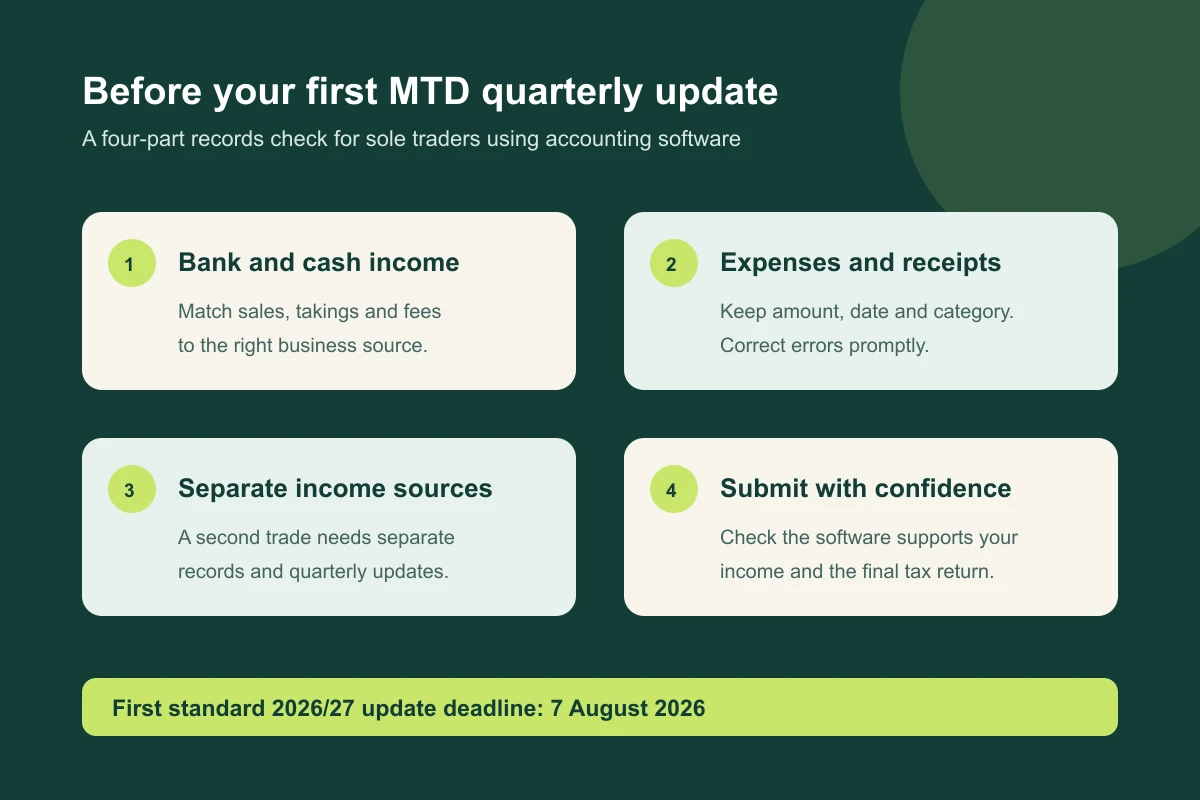
The MTD job is more specific than keeping a photo of a receipt in your phone. HMRC says digital records need the amount, date and category for income and expenses. A sole trader with two separate trades needs separate records and separate quarterly updates for each business. If you also have property income, you need to consider that source too.
Worked example 3: turnover decides who is in scope
Leah is a freelance photographer. Her 2024/25 Self Assessment return included £54,000 of gross photography income and £19,000 of allowable expenses. Her profit was £35,000.
It would be easy to focus on the £35,000 profit and assume MTD does not apply. For the first threshold check, the relevant figure is qualifying income. Her gross self-employment income is £54,000, so she is in the first MTD group if the other conditions are met.
Now add a small property income source. If Leah has £54,000 of self-employment income and £3,000 of gross property income, the software decision needs to cover both sources. It is worth checking the exact product route and asking your accountant what they can support before you sign up. This is one of those areas where the rules get a bit fiddly, particularly if you have property, partnership income, dividends, capital gains or a different accounting period.
A practical FreeAgent setup check before 7 August
The first quarterly update covers 6 April to 5 July 2026 for people using standard tax-year update periods. HMRC says there are no penalties for missing a quarterly update deadline in the 2026/27 tax year, but that should not be treated as permission to leave records until January. You still need digital records from the relevant start date and you will eventually need all four updates before the final tax return can be completed.
Use this checklist before treating a software subscription as finished:
- Connect the business bank feed, then review the opening balance and the first imported transactions rather than trusting every category rule.
- Add sales that do not arrive through the bank in a neat way, such as card processor settlements, cash takings or platform fees.
- Photograph or upload receipts while the purchase is still recognisable. A receipt called
IMG_4837rarely becomes clearer in six months. - Keep personal spending out of the business account where possible. If you do pay a business cost personally, record it clearly rather than forcing it into a bank-feed match.
- Confirm whether you have one trade, multiple trades, UK property income or foreign property income. The answer affects your record and submission setup.
- Run a report for 6 April to 5 July and compare it to your invoices, payment processor and bank activity before any quarterly update goes out.
- Ask your accountant or bookkeeper how they want access, review notes and year-end adjustments handled. Software does not replace a conversation about the accounts.
Our MTD compatible software guide explains the wider choice between cloud bookkeeping, spreadsheet-plus-bridging software and an accountant-managed approach. If your records are simple and you will keep them current, FreeAgent can be a sensible contender. If your business has several income sources or unusual tax matters, the right answer may be a different product or a combination of tools.
When FreeAgent can be a good fit, and when to pause
FreeAgent often suits a sole trader who wants invoicing, bank transactions, expenses and an accountant view in one place. It is especially attractive where the business bank account, invoice flow and record keeping are all fairly routine. The annual plan can be a tidy value choice if you have tried the workflow and know you will use it for a year.
Pause before committing if you run several distinct businesses, have both property and trade income, use a complicated VAT arrangement, need specialist integrations, or have a large backlog to clean up. The subscription cannot repair missing invoices or mixed personal spending. It only gives you a better place to fix them.
Prices and product features change, so check FreeAgent’s current terms before purchase and use HMRC’s finder for your MTD position. If you want a second pair of eyes on the setup before the first update, send us the records list you have and the income sources you need to report. That gives us something practical to check, rather than a software decision made on a price page alone.
FAQ: FreeAgent pricing UK for sole traders
How much is FreeAgent for a sole trader in the UK?
On 17 July 2026, the regular sole trader price shown by FreeAgent was £19 a month or £190 a year before VAT. Promotional pricing may apply for an initial period, but check the regular price and any add-ons before subscribing.
Is FreeAgent free with a business bank account?
Some qualifying business current accounts can include a £0 FreeAgent subscription route. Check the named account’s eligibility, ongoing transaction requirement, fees and the price of optional extras. Do not switch bank accounts only for the software without comparing the full cost.
Is the £190 annual FreeAgent price cheaper than monthly billing?
Yes, at the listed regular prices. Twelve payments of £19 equal £228 before VAT, compared with £190 before VAT annually. The difference is £38 before VAT, but annual billing needs the upfront payment.
Can I use FreeAgent for MTD for Income Tax?
Check your exact circumstances in HMRC’s software finder. You need a route that covers your digital records, income sources, quarterly updates and the tax return. Your own situation may differ, so get advice before relying on a single product for a more complicated return.

About Golden Tree Consulting
AAT Licensed | ACCA Affiliated
Golden Tree Accounting & Business Consulting provides expert tax, bookkeeping, and advisory services to sole traders and SMEs across Croydon, London, Surrey, and Kent. With multilingual support and decades of combined experience, we help businesses stay compliant and grow.
More Articles You Might Like
Continue exploring our financial insights
Cash Basis Accounting for Sole Traders 2026: Rules, Examples, and When to Use Traditional Accounting
Cash basis accounting for sole traders in 2026, with current HMRC rules, worked examples, MTD points, and when traditional accounting is better.

MTD Compatible Software for Sole Traders: 2026 Setup Guide
MTD compatible software for sole traders explained: what HMRC expects, how to choose tools, and what to test before quarterly updates.

MTD Quarterly Update Deadline 7 August 2026: Sole Trader and Landlord Guide
MTD quarterly update deadline 7 August 2026 explained for sole traders and landlords, with records, examples, and filing steps.