
Online Marketplace VAT Consultation: What UK Sellers Need to Know
Online marketplace VAT consultation explained for UK sellers, including the 18 August 2026 response deadline and practical record checks.
Online Marketplace VAT Consultation: What UK Sellers Need to Know
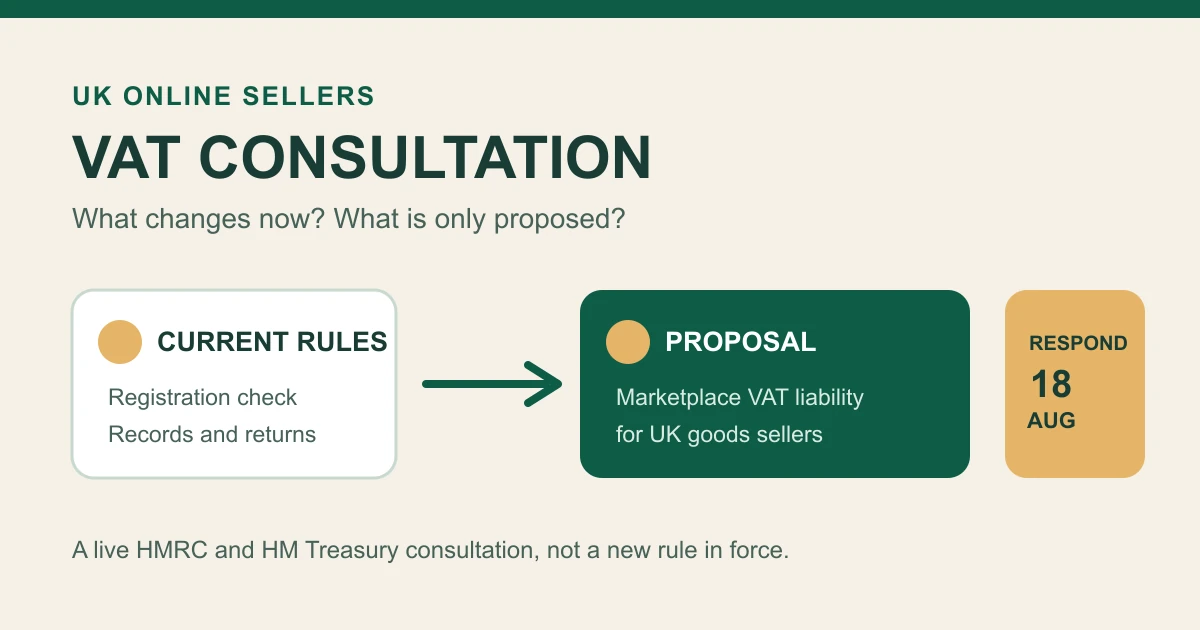
The online marketplace VAT consultation is easy to misread as a new tax bill for every person who has ever sold something on eBay. It is not. As at 31 July 2026, it is a live HMRC and HM Treasury consultation about whether online marketplaces should become responsible for accounting for VAT on certain sales made by UK-established businesses. The response deadline is 18 August 2026.
That distinction matters if you sell goods through Amazon, eBay, Etsy, TikTok Shop, a food-delivery platform, or another marketplace. The proposal could change the mechanics of VAT collection in future. It does not cancel your existing VAT duties today, and it does not turn an occasional private clear-out into a business overnight.
Quick summary: this is a proposal, not a rule in force. The consultation considers making marketplaces liable for VAT on sales they facilitate for UK businesses where the goods are in the UK at the point of sale. It also asks how to protect businesses below the £90,000 VAT registration threshold. If you trade through a marketplace, use the next two weeks to check your sales data, VAT registration position, stock location, and platform fees.
For help turning marketplace payouts into reliable VAT records, our VAT return service, bookkeeping support, and contact page are sensible places to start.
What is the online marketplace VAT consultation?
On 23 June 2026, HMRC and HM Treasury opened a consultation called Extending VAT online marketplace liability to combat non-compliance. It closes on 18 August 2026.
The government is considering an extension of rules that already apply in some overseas-seller situations. Its proposal is for an online marketplace to account for VAT on sales it facilitates for a UK business when the goods are in the UK at the point of sale. The stated aim is to tackle VAT non-compliance and reduce the advantage gained by sellers who do not follow the rules.
An online marketplace is not just any website that displays an advert. HMRC’s current guidance describes a marketplace as a platform that enables third-party sales and is involved in setting sale terms, processing or enabling payments, and ordering or delivery. A site that only processes payments, lists adverts, or redirects visitors may not meet that definition.
The consultation is aimed at marketplaces and UK businesses that use them to sell goods. It specifically says that private people selling second-hand goods who are not in business are not in scope of the proposed policy. That is useful reassurance, but it is not a blanket answer for someone who buys goods to resell regularly. The line between a private sale and trading depends on the facts, including the intention and pattern of activity.
What is changing now, and what is only proposed?
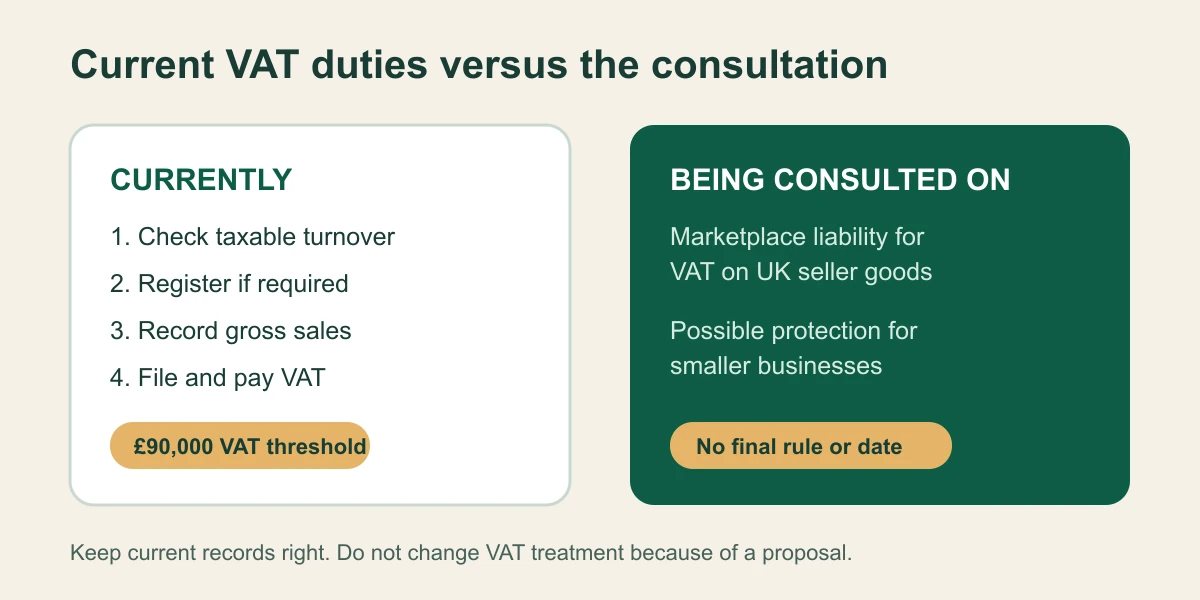
The practical answer is that your current VAT responsibilities have not changed because of this consultation. You still need to work out whether you are in business, whether your supplies are taxable, and whether you must register for VAT.
Under the current registration rules, a business usually must register if its taxable turnover goes over £90,000 in the previous 12 months, or if it expects taxable turnover to go over £90,000 in the next 30 days alone. Taxable turnover is not the profit left after marketplace fees, postage, stock, refunds, or advertising. It is the value of taxable supplies before VAT. Our VAT registration threshold guide explains the test in more detail.
The consultation does not say that every marketplace seller below £90,000 will automatically have VAT collected. In fact, the government is asking for views on ways to reduce the impact on businesses that are not required to register. Two ideas mentioned are a Minimum Platform Threshold, based on sales through each platform, and a VAT-rate relief for some businesses below the normal registration threshold. Neither is a final policy. Neither should be treated as a number you can plan around yet.
| Position on 31 July 2026 | What it means for a UK goods seller |
|---|---|
| Current VAT rules | You remain responsible for checking registration, charging VAT where required, filing returns, and keeping records. |
| Existing marketplace rules | Marketplaces already have VAT responsibilities in particular overseas-seller cases. |
| New consultation | The government is asking whether liability should extend to sales made by UK businesses through marketplaces. |
| Future date | No implementation date or final detailed rule has been confirmed in the consultation. |
That last row is the important one. Do not change your VAT treatment because a social-media post says a platform will “take care of VAT”. A platform deduction, a marketplace fee, and VAT you owe to HMRC are different things. The paperwork can be fiddly enough without mixing them together.
Why a marketplace payout is not a VAT calculation
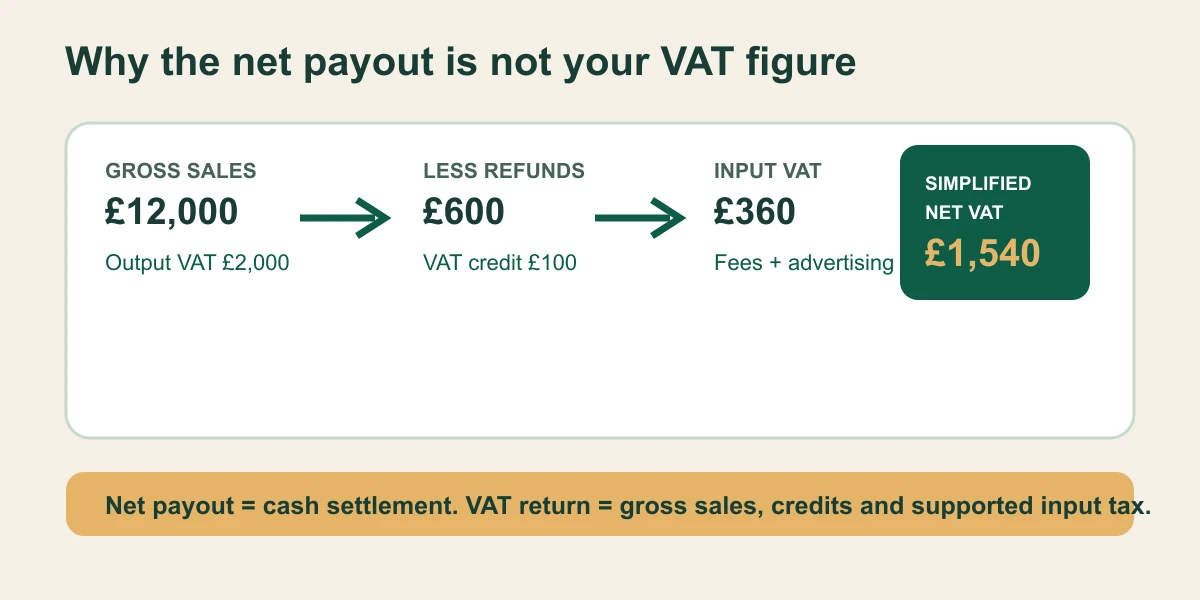
Marketplace reports often show a net payout. The money in your bank could be one week’s customer sales, less selling fees, payment charges, refunds, delivery labels, advertising, reserve amounts, or other adjustments. It is useful cash-flow information. It is not automatically the VAT figure for your return.
Say a VAT-registered seller receives a £9,600 payout from a platform for a period. The report behind it shows gross standard-rated sales of £12,000, customer refunds of £600, marketplace fees of £1,500 plus VAT, and advertising of £300 plus VAT. Assuming the supplies are standard-rated and the seller has valid VAT invoices for the fees and advertising, a simplified VAT review could look like this:
| Item | VAT treatment | VAT amount |
|---|---|---|
| Gross customer sales of £12,000 | Output VAT at 20% | £2,000 |
| Customer refunds of £600 | Reduction in output VAT | £100 credit |
| Marketplace fees of £1,500 plus VAT | Input VAT, if recoverable | £300 credit |
| Advertising of £300 plus VAT | Input VAT, if recoverable | £60 credit |
| Simplified net VAT before other purchases | £2,000 - £100 - £300 - £60 | £1,540 |
The net payout is not in that calculation because it is not a tax category. It is a settlement amount. The example is deliberately simple: zero-rated goods, exempt supplies, the Flat Rate Scheme, the Cash Accounting Scheme, partial exemption, overseas sales, and imports can all change the answer. Still, it shows why gross sales and supporting documents matter.
Worked example: below the threshold does not mean no records
Maya sells handmade homeware through two platforms. Her gross sales for the previous 12 months are £46,000 on one platform and £31,000 on the other. She also sells £8,000 through her own website.
Her total taxable turnover is £85,000. Based only on those figures, she is below the £90,000 registration threshold. It would be wrong, though, to check only the largest marketplace or only the amount reaching her bank after fees. If sales rise by £7,000 in the next 30 days, she would expect to exceed £90,000 in that period and may need to register then.
The consultation is relevant because it asks about a per-platform threshold as a possible future design. That has no effect on Maya’s current registration test. Today, she needs one complete turnover record across every channel. If a policy eventually uses platform-level data, having separate reports already reconciled will make life less painful.
Worked example: VAT registration makes the report more important
Ben is already VAT registered. He sells £110,000 of standard-rated goods in a year, made up of £70,000 via a marketplace and £40,000 direct from his website. His VAT return needs both sales channels. The platform cannot quietly remove the direct sales from the picture.
If the marketplace’s report shows £70,000 gross sales including VAT, output VAT in that gross figure is £11,666.67 using the VAT fraction of 1/6. That is not £14,000. The £14,000 calculation would apply if £70,000 were a net amount before VAT. A clean report needs to say which figure it is, and your bookkeeping needs to use the matching treatment.
What the consultation could mean for different sellers
The proposal is about sales of goods through an online marketplace, not a general change to Income Tax, Corporation Tax, or platform reporting rules. It may still affect a broad mix of businesses, from a one-person online shop to a takeaway using a delivery platform.
VAT-registered marketplace sellers
If you are already registered, do not assume a future marketplace-liability model would end your work. You could still need to keep records, reconcile reports, account for direct sales, issue documents correctly, and make other VAT adjustments. The consultation asks about administrative and commercial impacts, which is a good reason to record the real effort involved now.
For example, a platform could have better transaction-level data than a small retailer. It could also have less context about a refund, a bundled product, a cross-channel promotion, or a sale that was cancelled outside its system. The exact design matters.
Businesses below the VAT threshold
The government explicitly asks how to minimise the effect on businesses that do not have to register for VAT. That is a signal that the design is not settled. A small seller should not register early just because of the consultation, but should keep a close eye on taxable turnover.
The £90,000 threshold is tested against rolling periods, not only the tax year or a calendar year. A spreadsheet that resets on 1 January can give false comfort. Our bookkeeping service can set up a regular turnover check alongside the usual bank reconciliation.
Private sellers and side hustles
The consultation says non-business private sellers are not in scope. That does not settle whether your own activity is a trade. Someone selling their used bicycle occasionally is in a different position from someone sourcing stock, listing it frequently, and aiming to make a profit.
There is also a separate issue: digital platforms can collect and report seller information to HMRC under the platform reporting rules. Receiving a platform message about reporting does not, by itself, mean you owe tax or must register for VAT. It is a reason to make sure your records are accurate. Our side-hustle tax guide covers the Income Tax starting point.
A practical check before 18 August 2026
The consultation asks for evidence on administrative, commercial, and operational impacts. A generic “this will be difficult” response is less helpful than a short explanation with real figures and process steps. You do not need to be a trade body to respond.
Use this checklist first:
- Export gross sales, refunds, fees, advertising, and reserve data from each marketplace.
- Identify where the goods are at the point of sale, particularly if you use fulfilment warehouses.
- Separate marketplace sales from sales through your own website, wholesale, and in-person channels.
- Check your rolling 12-month taxable turnover against £90,000, and your next 30-day forecast.
- Compare the platform reports with your accounting software and bank payouts. Investigate any unexplained difference.
- Note the time spent correcting reports, handling refunds, or collecting VAT evidence. That is useful consultation evidence.
- If the proposal would affect you, read the official consultation questions and respond by 18 August 2026.
There is no prize for producing a complicated response. A clear example is more useful: “We sell £X a year on two platforms, use three VAT rates, and need four hours a month to reconcile refunds and fees.” That gives policymakers something concrete to assess.
What we would do this month
Keep your current VAT process accurate, rather than guessing at a proposal that may change. Make sure product sales are recorded gross, platform fees have supporting invoices, refunds are not lost, and every sales channel is in the turnover check. If you are due to file a VAT return, our VAT return deadline guide has the regular filing timetable.
If the consultation affects your business model, send a focused response before 18 August 2026. Then keep the evidence pack. Whatever final policy emerges, a business that can explain its sales, fees, stock location, and VAT treatment is in a much better position than one trying to reconstruct it from net payouts.
Frequently asked questions
Is the online marketplace VAT change law yet?
No. On 31 July 2026, it is a consultation. The government is seeking views on a proposal, and the final approach could be different from the options described now.
Will occasional private sellers have to charge VAT?
The consultation says people who are not in business and sell second-hand goods privately are not in scope of the proposed policy. If your activity looks like regular trading, take advice rather than relying on the label you use for it.
Do UK marketplace sellers need to register for VAT now?
Current rules still apply. You normally register if taxable turnover exceeds £90,000 in the last 12 months or you expect to exceed £90,000 in the next 30 days alone. The consultation does not replace either test.
What should an online seller do before 18 August 2026?
Check gross sales, fees, refunds, stock location, and all sales channels. If the proposal would materially affect your costs or process, respond through the official consultation with specific evidence before the deadline.

About Golden Tree Consulting
AAT Licensed | ACCA Affiliated
Golden Tree Accounting & Business Consulting provides expert tax, bookkeeping, and advisory services to sole traders and SMEs across Croydon, London, Surrey, and Kent. With multilingual support and decades of combined experience, we help businesses stay compliant and grow.
More Articles You Might Like
Continue exploring our financial insights
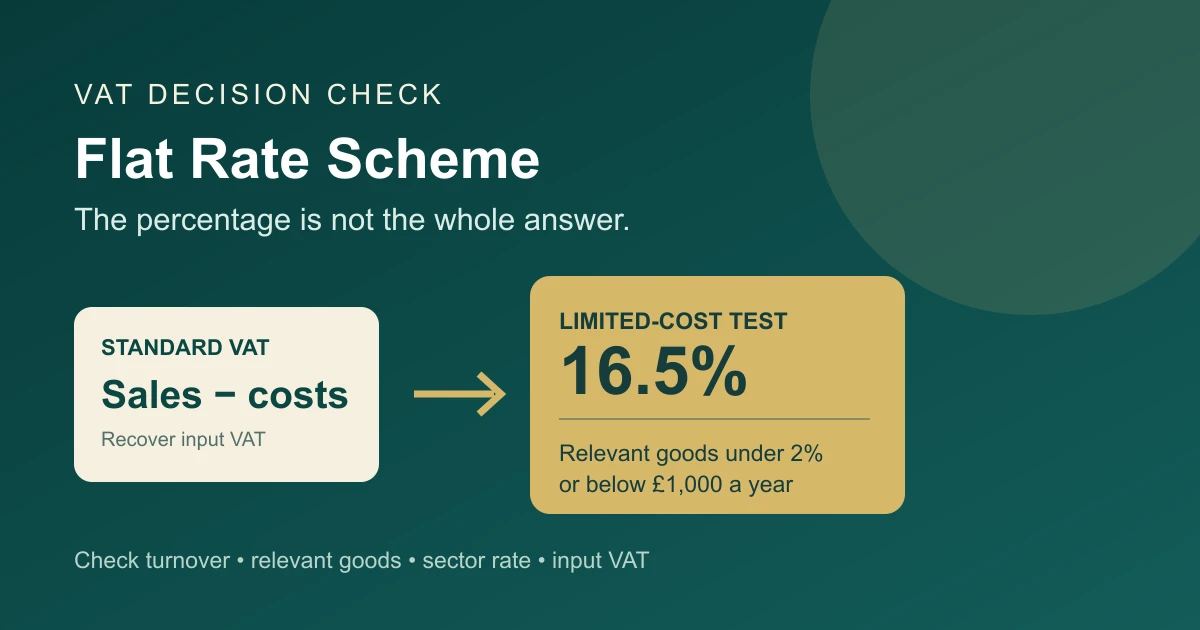
VAT Flat Rate Scheme 2026: Is the 16.5% Rule Costing Your Business Money?
VAT Flat Rate Scheme 2026 guide for small businesses, covering the 16.5% limited-cost rule, thresholds, examples and exit checks.

Etsy Seller Tax UK: 2026 Guide to Records, VAT and Self Assessment
Etsy seller tax UK guide for 2026: the £1,000 trading allowance, Self Assessment, VAT threshold, expenses and records to keep.
VAT Return Dates 2026: UK Deadline Guide for Small Businesses
VAT return dates 2026 explained for UK small businesses, with quarterly deadlines, payment dates, penalties, and examples.